Showing posts with label books. Show all posts

Sunday, February 6, 2011

existentialism is a humanism


(in an effort to not forget what I read this year I will record each completed book here)

I'm currently on a stint of reading the first novels of recognized contemporary authors to see what they produced the first time around. However, concurrently, I've digressed slightly into some philosophy texts. This set of essays here by JPS was inspired by recently reading L'Etranger by Albert Camus (sometimes translates as The Stranger and other times as The Outsider). One of the essays is a commentary on the novel, JPS articulates why L'Etranger is strikingly different from anything that ever preceded it. Further, this is interesting as Camus and Sartre have not yet met at this point, when they did meet they became fast friends, until their views diverged and they became critical of one another.

There is another great essay that puts into somewhat simple terms what existentialism is and how it is not what people think it is.

"What do we mean here by "existence precedes essence"? We mean that man first exists: he materializes in the world, encounters himself, and only afterwards defines himself."


"Whatever he (man) does, he cannot avoid bearing full responsibility for his situation. He must choose without reference to any preestablished value, but it would be unfair to tax him with capriciousness. Rather, let us say that moral choice us like constructing a work of art."


"What art and morality have in common is creation and invention. We cannot decide a priori what ought to be done"


Camus writes: "A man is more of a man because of what he does not say than what he does say."


"That is because silence, in the words of Heideger, is the authentic mode of speech. Only he who can talk keeps silent"


"Kafka is the novelist of impossible transcendence; for him, the universe is full of signs that we cannot understand; there is something behind the scenery. For Camus, to the contrary;the tragedy of human existence lies in the absence of any transcendence."


"Each sentence refuses to exploit the momentum gained from the preceding one."


"...it is designed in such a way that things are transparent and meaning are opaque."


Wednesday, January 12, 2011

books, Man walks into a room

by Nicole Krauss

On a stint of reading the first novels by the new garde of contemporary authors. Curious as to what they produced the first time around.

"Its unforgiving. You have to move through it at right angles. But I feel a great deal of warmth for this house. Like a woman you loved who spurned you for years, to whom you feel a certain gratitude because you realize she gave shape to your life."

"She held her cigarette limpidly between two fingers. It surprised him how easily she handled things, how fluently she shared her life with the hundreds of objects that passed through her hands"

Thursday, June 24, 2010

books, do consider the lobster

I continue on the dfw stint:


In any event, at the Maine Lobster Festival (MLF), standing by the bubbling tanks outside the World's Largest Lobster Cooker, watching the fresh-caught lobsters pile over one another, wave their hobbled claws impotently, huddle in the rear corners, or scrabble frantically back from the glass as you approach, it is difficult not to sense that they're unhappy, or frightened, even if it's some rudimentary version of these feelings... and, again, why does rudimentariness even enter into it? Why is a primitive, inarticulate form of suffering less urgent or uncomfortable for the person who's helping to inflict it by paying for the food that it results in? I'm not trying to give you a PETA-like screed here—at least I don’t think so. I’m trying, rather, to work out and articulate some of the troubling questions that arise amid all the laughter and saltation and community pride of the Maine Lobster Festival. The truth is that if you, the Festival attendee, permit yourself to think that lobsters can suffer and would rather not, the MLF can begin to take on aspects of something like a Roman circus or medieval torture-fest.

Does that comparison seem a bit much? If so, exactly why? Or what about this one: Is it not possible that future generations will regard our own present agribusiness and eating practices in much the same way we now view Nero’s entertainments or Aztec sacrifices? My own immediate reaction is that such a comparison is hysterical, extreme—and yet the reason it seems extreme to me appears to be that I believe animals are less morally important than human beings; and when it comes to defending such a belief, even to myself, I have to acknowledge that (a) I have an obvious selfish interest in this belief, since I like to eat certain kinds of animals and want to be able to keep doing it, and (b) I have not succeeded in working out any sort of personal ethical system in which the belief is truly defensible instead of just selfishly convenient.


-David Foster Wallace

Monday, June 14, 2010

books, A Little Fable

"Alas," said the mouse, "the world is growing smaller every day. At the beginning it was so big that I was afraid, I kept running and running, and I was glad when at last I saw walls far away to the right and left, but these long walls have narrowed so quickly that I am in the last chamber already, and there in the corner stands the trap that I must run into." "You only need to change your direction," said the cat, and ate it up.
-Kafka

Sunday, June 13, 2010

books, Brief Interviews with Hideous Men

A RADICALLY CONDENSED HISTORY OF POSTINDUSTRIAL LIFE

When they were introduced, he made a witticism, hoping to be liked. She laughed extremely hard, hoping to be liked. Then each drove home alone, staring straight ahead, with the very same twist to their faces.

The man who'd introduced them didn't much like either of them, though he acted as if he did, anxious as he was to preserve relations at all times. One never knew, after all, now did one now did one now did one.

-David Foster Wallace

Monday, May 17, 2010

books, the interrogation


Adam seemed to be alone in this ability to die whenever he wanted, a private hidden death; the only living creature in the world who was passing insensibly, his flesh not decaying and putrefying, but freezing into a mineral. - Le Clezio, from The Interrogation


At the conclusion of a life full of concentrated memories it was a kind of pale phantom in ghostly outline, like a dingy patch of snow; it was leaking away over the brown floor, evasive and persistent. It was a lobular cloud, or a fleck of soft foam, dissociated from blood and terror, sailing on the surface of dirty water. It was what remains from an instant of linen-washing, what floats, what turns blue, what traverses the thick of the air and bursts before ever it can be polluted, before ever it can be killed. - Le Clezio, from The Interrogation

books, shantaram


She loved the guy. She did it for him. She would have done anything for him. Some loves are like that. Most loves are like that, from what I can see. Your heart starts to feel like an overcrowded lifeboat. You throw your pride out to keep it afloat and your self respect and your independence. -Gregory David Roberts, from Shantaram

Monday, April 19, 2010

books, stop-time


Perhaps children remember only waiting for things. The moment events begin to occur they lose themselves in movement.
- Frank Conroy, from the memoir stop-time

Saturday, April 10, 2010

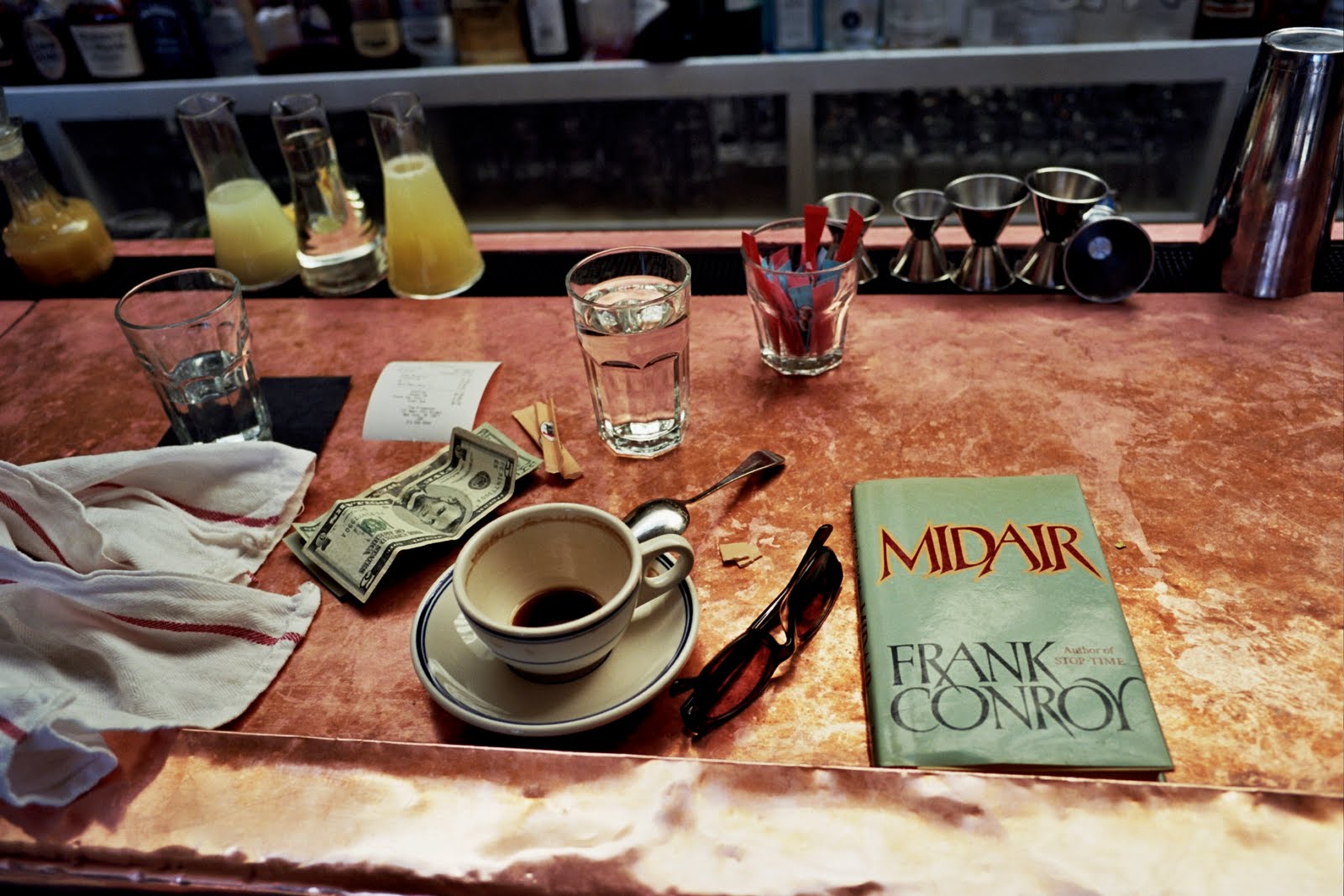
books, midair


Reading a collection of New Yorker short stories I discovered Frank Conroy. I thought there was something perfect about the following passage describing an interaction between father (Sean) and son (Philip).


"Why were you crying?" Philip asks.
Sean stops at the top of the stairs. His first thought is not how the boy knows but if the knowledge has scared him. He goes into the room, and there is Philip, wide awake, kneeling at the foot of his bed, an expectant look on his face.
"Hi." Sean can see the boy is not alarmed. Curious, focussed, but not scared.
"Why" the boy asks. He is six years old.
"Grownups cry sometimes, you know. It's O.K."
The boy takes it in, still waiting.
"I'm not sure," Sean says. "It's complicated. Probably a lot of things. But it's O.K. I feel better now."
"That's good."
Sean senses the boy's relief. He sits down on the floor. "How did you know I was crying?" He has never felt as close to another human being as he does at this moment. His tone is deliberately casual.
The boy starts to answer, his intelligent face eager, animated. Sean watches the clearly marked stages: First, Philip draws a breath to begin speaking. He is confident. Second, he searches for language to frame what he knows, but, to his puzzlement, it isn't there. Third, he realizes he can't answer the question. He stares into the middle distance for several moments. Sean waits, but he has seen it all in the boys face.
"I don't know," the boy says. I just knew."
"I understand."
After a while the boy gives a sudden large yawn, and gets under the covers. Sean goes downstairs.

Sunday, December 6, 2009

Waiting for film


Some notes from the travel note book.

"But Amory, being on the spot, leaned over quickly and kissed Myra's cheek. He had never kissed a girl before, and he tasted his lips curiously, as if he had munched some new fruit. Then their lips brushed like young wild flowers in the wind"
F. Scott Fitzgerald

"Feeling things (which usually means feeling them painfully) is at some level linked to the acquisition of knowledge"

"A wild longing for strong emotions and sensations seethes in me, a rage against this toneless, flat, normal and sterile life"
H. Hesse

ShareThis